The role of infrared spectroscopy
The use of molecular vibrations to probe structure in hydrogen bonding liquids.
Artiklen har været bragt i Dansk Kemi nr. 1, 2026 og kan læses uden illustrationer, strukturer eller ligninger herunder
(læs originalartiklen her)
By Evangelos Drougkas, Georgios M. Kontogeorgis and Xiaodong Liang, Center for Energy Resources Engineering, DTU Kemiteknik, and Henrik G. Kjaergaard, Department of Chemistry, University of Copenhagen
Hydrogen bonding compounds have a strong presence in many industrial and chemical processes. To tackle the challenge that many thermodynamic models face in the description of their properties, novel experimental data of their structure are of great importance to the chemical engineering community. Vibrational spectroscopy is an accessible yet invaluable tool for inferring the microscopic picture of hydrogen bonding, and its pairing with profound theoretical tools can help revolutionize chemical thermodynamics.
Describing the ”network”
A vast range of industrial applications involves hydrogen bonding substances, and the accurate prediction of their physical properties lays the groundwork for the design of advanced and efficient processes. Among them, water has arguably the largest number of applications, but despite its commonness a conclusive model that can capture its unique thermophysical property profiles remains as the “holy grail” of modern applied thermodynamics. Specifically, traditional equations of state fail to account for water’s anomalous properties, such as its maximum density or minimum heat capacity as a function of temperature.
There is consensus among the modeling community that the primary factor for water’s peculiar property profiles is its strong intermolecular interactions with an intense orientational character, commonly referred to as hydrogen bonding [1]. Most advanced models incorporate special terms that involve a key structural parameter: the number of molecules that do not participate in hydrogen bonds as donors, known as the free hydroxyl fractions. A traditional and highly accessible tool for the analysis of hydrogen bonding at the molecular level is infrared spectroscopy, a common technique that studies the transitions between molecular vibrational states. Hydrogen bonding induces changes in the vibrational patterns of hydroxyl groups, generating complex spectra that encode orientational information using vibrations as a proxy.
From spectra to free hydroxyl fractions
The analysis of temperature-varied vibrational spectra for the estimation of the degree of hydrogen bonding has been the subject of multiple works over the past 80 years. Among them, one empirical approach has survived the test of time, having been greatly utilized by the thermodynamics community. The works of Werner Luck have provided free hydroxyl fraction data for a wide temperature range for methanol, ethanol and water [2]. While these important data have found use in the calibration of the association terms of equations of state, they have surprisingly not been replicated or consolidated in later studies.
Contemporary computational means enable the investigation of the free hydroxyl group fraction problem, challenging the previous attempts. Taking methanol as a base case, quantum mechanical techniques are used for the geometry optimization of several methanol clusters. The vibrational properties of the hydroxyl stretching modes are determined with the local vibrational mode methodology [3], a highly customizable approach that relies on first principles and allows for the efficient calculation of spectroscopic peak positions and intensities.
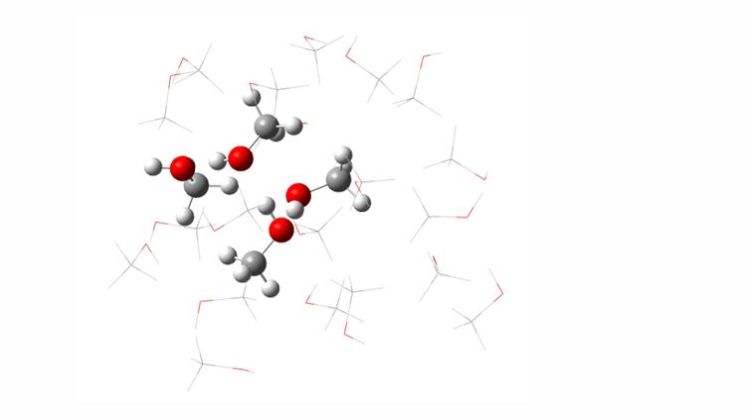
A consideration commonly encountered during the application of quantum calculations is their default conduction at “vacuum” conditions. For increased tangibility to the liquid phase, this issue is amended with the application of solvation models, with the latest trends favoring the use of several “layers” of explicit molecules that are analyzed with lower levels of theory, such as semiempirical methods or molecular dynamics. An example of a chain-like cluster surrounded by explicit solvent molecules is shown in figure 1. Hence, balancing robustness and complexity is the key for efficient calculations on large systems with meaningful relevance to condensed states.
To simplify the complex near-infrared spectrum of methanol, measurements are conducted on its deuterated variants. The statistical analysis of the measured bands allows for the isolation of the free hydroxyl stretching band and the observation of its intensity change with respect to temperature. Combined with the theoretical intensity predictions, quantitation can be achieved. The basic principle behind this is illustrated in figure 2.
The new results (shown in figure 3) reveal a large disagreement with older empirical techniques [4].
The free hydroxyl fractions are found to be an order of magnitude lower than previously believed. This indicates that the overwhelming majority of hydrogen bond sites are actively participating in intermolecular interactions. This behavior persists even for temperatures approaching the normal boiling point of methanol, hinting at the strength of the hydrogen bond network that dominates the condensed phases of methanol.
While these initial results defy the picture painted by the milestone studies of the previous century, further investigation is conducted at the moment to ascertain the conclusions about the structural intricacies of liquid methanol.
Ongoing studies on solvation modeling and the inclusion of important intermolecular vibrational modes are bound to offer credibility on the implementation of the elaborate local mode methodology. Furthermore, collection of data on more regions of methanol’s spectrum is imminent, as well as the study of more relative compounds such as other light alcohols, paving the way for the rejuvenation of the hydrogen bond thermodynamic modeling framework and closing the distance towards a resolution of bulk water/aqueous electrolyte systems.
Acknowledgements
The authors would like to thank the European Research Council (ERC) for funding this work under the European Union’s Horizon 2020 research and innovation program (Grant Agreement No. 832460), ERC Advanced Grant project “New Paradigm in Electrolyte Thermodynamics”. Co-funded by the European Union (ERC, REMOTE, 101171135). Views and opinions expressed are, however, those of the author(s) only and do not necessarily reflect those of the European Union or the European Research Council Executive Agency. Neither the European Union nor the granting authority can be held responsible for them.
E-mail:
Evangelos Drougkas: evadr@kt.dtu.dk
Georgios M. Kontogeorgis: gk@kt.dtu.dk
Xiaodong Liang: xlia@kt.dtu.dk
References
1. E. Arunan et al., “Definition of the hydrogen bond (IUPAC Recommendations 2011),” Pure and Applied Chemistry, vol. 83, no. 8, pp. 1637-1641, Jul. 2011, doi: 10.1351/PAC-REC-10-01-02.
2. W.A.P. Luck, “A Model of Hydrogen-Bonded Liquids,” Angewandte Chemie International Edition in English, vol. 19, no. 1, pp. 28-41, 1980, doi: 10.1002/ANIE.198000281.
3. E. Vogt, A.S. Hansen, and H.G. Kjaergaard, “Local Modes of Vibration: The Effect of Low-Frequency Vibrations,” in Molecular Spectroscopy, vol. 2, Y. Ozaki, M.J. Wójcik, and J. Popp, Eds., Wiley-VCH Verlag GmbH & Co. KGaA, 2019, ch. 14, pp. 389-424. doi: 10.1002/9783527814596.ch14.
4. E. Drougkas et al., “Application of the Local Vibrational Mode Framework for the Spectroscopic Estimation of Free Hydroxyl Group Fractions in Pure Liquid Methanol-d3,” J Phys Chem B, pp. 129-10824, Oct. 2025, doi: 10.1021/ACS.JPCB.5C03059.
BOKS:
Deuteration
The substitution of methanol’s methyl hydrogen atoms with deuterium leads to a shift to the peaks related to methyl-related vibrational transitions, simplifying the statistical treatment of the spectra specifically for the treatment of the hydroxyl bands.